
Arriving connected in Buenos Aires depends on a few straightforward decisions to address before boarding your flight: choosing the right mobile network, checking if your charger works with local power outlets, and dressing appropriately for the season. This guide gathers all essential operational details in one place, specifically designed for business travelers who cannot afford unexpected downtime.
Mobile networks and frequencies in Buenos Aires
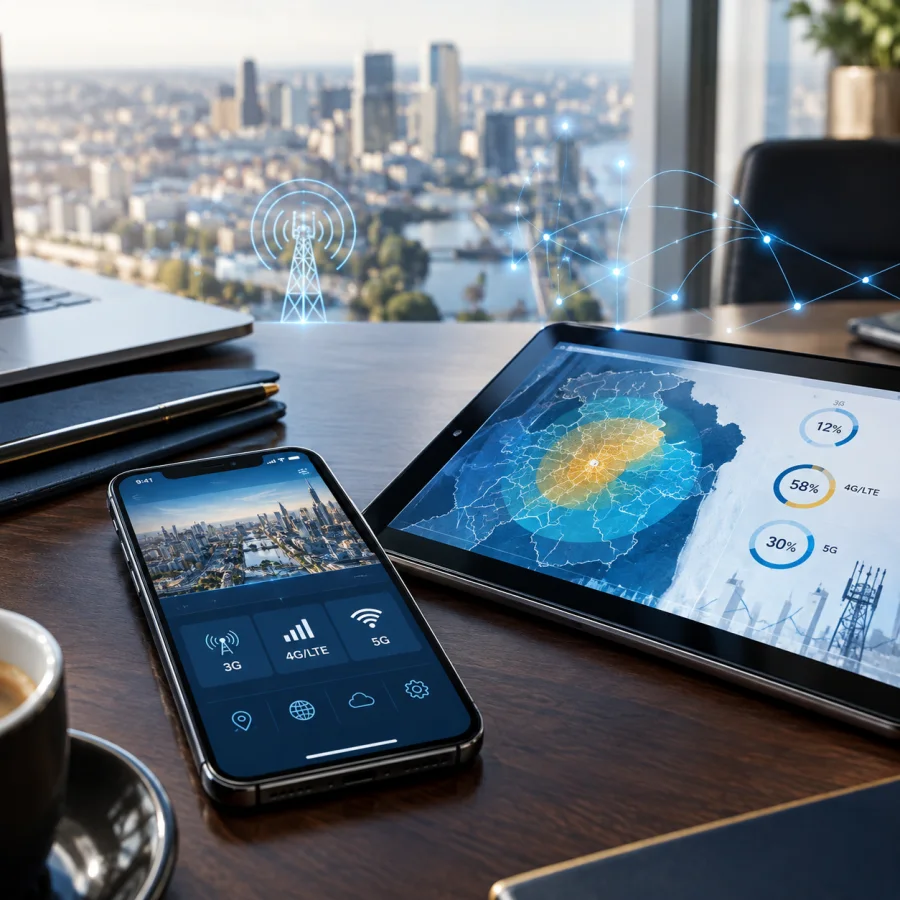
Three major mobile carriers operate in Argentina: Movistar, Claro, and Personal. All three provide extensive 4G/LTE coverage across the City of Buenos Aires and the Greater Buenos Aires area, with data speeds in the metropolitan region consistently ranking among the highest nationwide.
The rollout of 5G infrastructure is underway, though currently partial: recent network speed measurements show Personal leading in coverage and consistency throughout the metropolitan area, followed by Claro, while Movistar maintains a more limited presence. In practice, while visitors may encounter 5G in specific pockets of CABA, 4G connections remain the standard for uniform coverage citywide and should be relied upon for scheduling video calls or transferring large files.
Regarding phone compatibility for international devices: Argentine networks operate primarily on 850 MHz and 1900 MHz bands for 3G, and 700, 1700/2100 (AWS), and 2600 MHz bands for 4G, depending on the carrier. Most multi-band smartphones manufactured for the United States, Europe, Brazil, and Latin America in recent years will work seamlessly. However, travelers should verify that their specific device supports these frequency bands prior to departure [VERIFY: confirm exact frequency bands supported by your phone model before traveling, as hardware specifications vary by manufacturer and region of origin].
How to stay connected: roaming, eSIM, and local SIM cards
To maintain seamless communications upon landing, travelers can choose between three main options:
- Activating international roaming with your home carrier: this is the simplest option, but typically the most expensive per megabyte, particularly for travelers arriving from outside the Mercosur region. Review daily rates or international data packages with your carrier before activating roaming.
- Purchasing an international eSIM prior to travel: providers such as Airalo, Holafly, or Ubigi offer data plans for Argentina that activate via QR code scanning without removing your physical SIM card. Installation is best completed over wifi before departure, with activation occurring automatically upon arrival.
- Buying a local physical SIM card: available at convenience stores, carrier retail locations, and inside Ezeiza International Airport. Local SIMs generally offer higher data allowances per dollar compared to international eSIMs, but require an unlocked phone and spending time on registration during arrival.
For executive travelers, an eSIM provides the optimal balance between convenience and expense control: it eliminates the need to locate a physical store after landing, keeps your primary phone number active for calls and two-factor authentication codes, and caps data spending at the agreed package rate. Ensure your device is carrier-unlocked and eSIM compatible before traveling (usually checked by dialing *#06# or inspecting cellular settings).
Public wifi security and the role of a VPN
Buenos Aires provides widespread public wifi access in executive venues, including airports, hotels, business hubs, and cafes across Microcentro and Puerto Madero. However, open networks carry inherent security trade-offs: because they are shared and unencrypted, data transmissions may be vulnerable to interception by other network users equipped with basic analytical tools.
When connecting to public wifi networks, consider the following best practices:
- Verify the precise network name with staff to avoid connecting to fraudulent networks designed to mimic legitimate business access points.
- Refrain from conducting online banking or entering sensitive account credentials while connected to unencrypted public networks.
- Disable automatic network joining on your device to prevent unintended connections to malicious networks broadcasting common network identifiers.
A Virtual Private Network (VPN) encrypts data traffic between your device and remote servers. When accessing corporate email, internal business platforms, or processing payments during travel, enabling a VPN on public wifi significantly mitigates credential exposure. While failing to use a VPN does not guarantee a security breach, operating without one leaves unencrypted data unprotected across networks outside your administrative control.
Power supply in Argentina: voltage, plugs, and adapter requirements
Argentina operates on a 220 V supply voltage at 50 Hz, contrasting with the 110–120 V and 60 Hz standard used in the United States and parts of Central America. The official electrical outlet is Type I, featuring three flat pins arranged in a V-shape with a grounding pin. While visually similar to the Australian plug format, pin angles may vary slightly; travelers should use an adapter designed specifically for Argentina. Type C outlets (two round pins) may also be encountered occasionally.
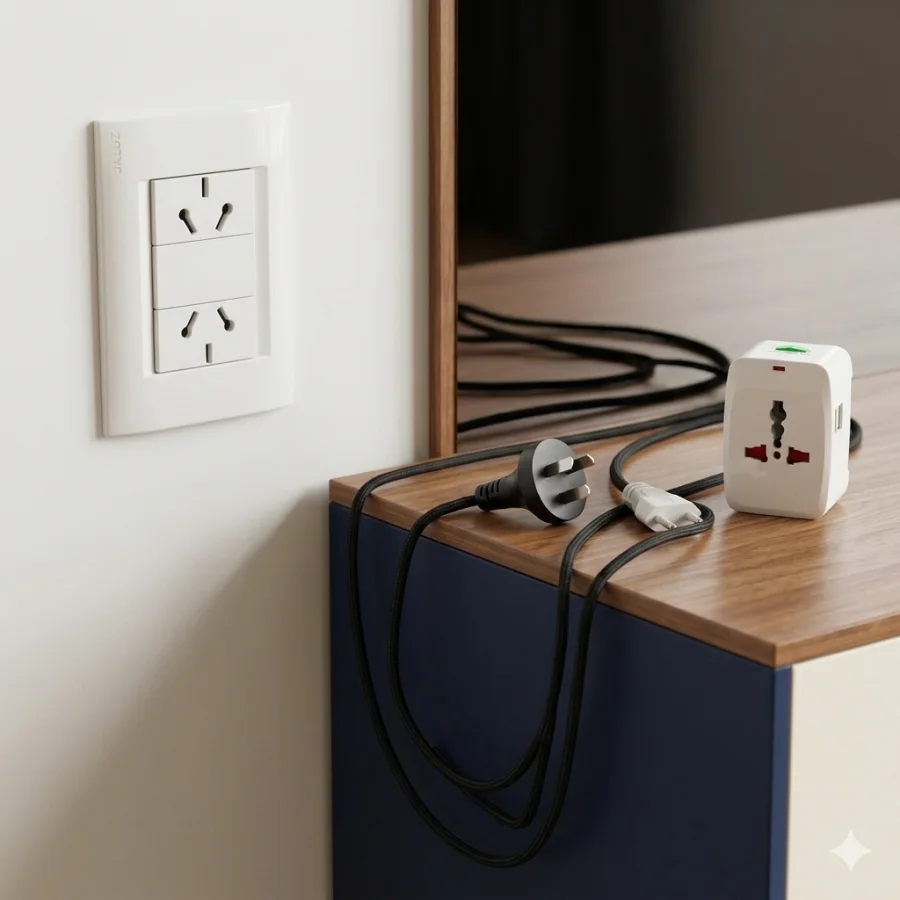
Power adapter guidelines by origin:
- From the United States: modern laptop and smartphone chargers are almost universally dual-voltage (100–240 V, indicated under "INPUT" on the plug casing), requiring only a physical plug adapter. Single-voltage appliances, such as older hair dryers or styling tools, require a voltage converter.
- From Brazil: Brazilian Type N plugs are incompatible with Argentine outlets and require a physical adapter. Voltage compatibility depends on your home region in Brazil (127 V vs. 220 V).
- From Europe: European Type C or F plugs require a physical adapter to fit Type I outlets, though 220–230 V power ratings are fully compatible without voltage transformation.
- From other Latin American regions: compatibility varies by country of origin. Carrying a universal adapter with Type I configuration is recommended.
Selecting a universal adapter featuring Type I pins ensures compatibility across Argentina and during international transit. Adapters are available at Ezeiza International Airport, electronics retailers, and major pharmacies in central Buenos Aires, though purchasing prior to departure is advised.
Time zone, seasonal shifts, and wardrobe planning
Argentina operates on Argentine Time (ART, UTC-3) year-round without observing daylight saving time adjustments. Consequently, time differences relative to your origin remain constant throughout your stay.
Located in the Southern Hemisphere, seasons in Buenos Aires are inverted relative to Europe and North America:
- Summer (December 21 – March 21): temperatures frequently exceed 30 °C (86 °F) with high humidity. Daylight hours are extended, with early sunrises and late evening sunsets.
- Autumn (March 21 – June 21): moderate temperatures averaging between 15 °C and 20 °C (59–68 °F), accompanied by gradually shortening daylight.
- Winter (June 21 – September 21): morning and evening temperatures may drop to 5 °C (41 °F) or lower. Coastal humidity from the Río de la Plata heightens perceived cold. Daylight hours are shortest.
- Spring (September 21 – December 21): mild temperatures ranging from 15 °C to 25 °C (59–77 °F), with lengthening days transitioning toward summer.
For summer travel, lightweight and breathable attire is recommended, alongside a light jacket for rain showers. Winter requires layered garments and a windproof coat to offset coastal humidity. Layered clothing is ideal for autumn and spring to adapt to temperature variations between morning and afternoon.
Managing your arrival logistics—from data connectivity to power adapters and weather preparation—ensures uninterrupted productivity. By coordinating airport transit through a dedicated executive service like Aryes Traslados, business travelers can proceed directly to scheduled engagements without managing ground logistics upon landing.
Frequently asked questions
Do I need a different plug adapter depending on my country of origin?
Yes. Argentina utilizes Type I outlets. Unless your home country uses the same standard, a plug adapter is required. Most modern chargers support 220 V automatically, but individual device ratings should be verified before connection.
Is an eSIM preferable to buying a local SIM card upon arrival?
It depends on your priorities: an eSIM saves time by activating prior to departure without requiring in-country paperwork. A local physical SIM typically offers higher data volume per dollar but requires an unlocked device and visiting a retail location.
Is a VPN necessary when connected to hotel wifi?
Hotel networks are generally more secure than unencrypted public wifi, but remain shared environments. Using a VPN when handling corporate data, financial transactions, or passwords adds essential encryption to protect sensitive credentials.
‹ Back to blog