
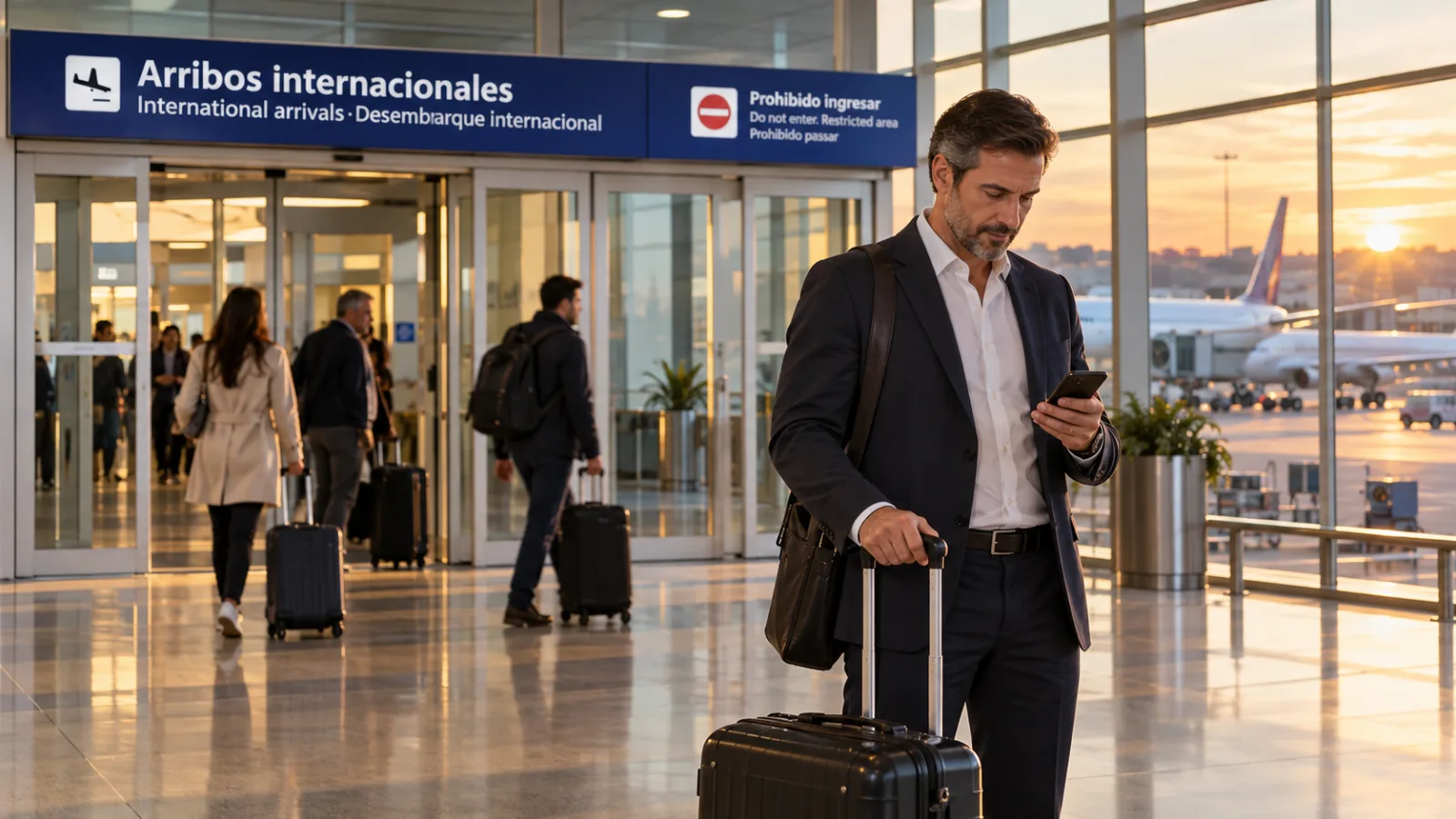
There is a moment, between the time a flight lands and a passenger finally boards a vehicle, that almost never appears in descriptions of transfer services. People talk about the car, the driver, punctuality, and the route. Almost no one talks about the minutes of waiting. And yet, that silent stretch—standing at the arrivals door, staring at the phone, looking for a sign with one's name on it—is usually the moment when the perception of the entire service is truly decided.
This is not an isolated intuition. The person who studied this phenomenon most thoroughly was David Maister, a consultant and professor who in 1985 published a text that remains a reference in service management today: "The Psychology of Waiting Lines". Maister started from an uncomfortable idea for any company competing by the minute: actual waiting time and perceived waiting time almost never coincide, and it is the latter that ultimately defines whether a customer returns or not.
Time does not weigh the same when you do not know how long it will last
Maister formulated eight propositions on how people experience waiting, and several of them accurately describe what happens during an international arrival. The first, and perhaps the most cited, echoes philosopher William James: boredom—and by extension the anxiety of waiting—arises from being attentive to the passage of time. When a person has nothing to do except watch the clock, every minute stretches out.
However, there are two propositions even more relevant for an airport transfer. The third states that anxiety makes waits feel longer than they actually are on the clock. The fourth adds something crucial: an uncertain wait feels longer than a known wait, even if it lasts the exact same amount of time. Maister illustrates this with the example of a patient in a medical waiting room: if told the doctor will take thirty minutes, there is an initial annoyance, but afterward the person relaxes because they know what to expect. What erodes patience is not the delay itself, but not knowing how long it will last.
Added to this is the fifth proposition: an unexpressed wait feels longer than an explained wait. The absence of information generates, in Maister's words, a feeling of powerlessness that fuels irritation. And the sixth speaks of fairness: when someone perceives that the process is unfair—for example, that another passenger was attended to first without apparent reason—tolerance for waiting plummets, even if the objective time is short.
Translated to a real arrival: a traveler who has just stepped off a ten- or twelve-hour flight, with a desynchronized biological clock and no exact knowledge of where their driver is, is not simply "waiting around." They are going through, in psychological terms, one of the most anxiety-prone situations of the entire journey.
The numbers behind that anxiety
This does not stay merely in the realm of theory. A survey by transport platform Mozio regarding what they call arrival anxiety among international travelers yielded data worth examining closely. Thirty-nine percent of respondents identified the journey between the airport and accommodation as the most stressful part of traveling abroad, surpassing other moments like immigration controls or the flight itself. And 69% admitted to modifying a booking, or paying more, specifically due to arrival-related concerns.
What exactly is the concern? According to the same survey, the main sources of anxiety are the fear of overcharges or scams, not knowing exactly where and with whom they will meet upon exiting arrivals, and the difficulty of communicating in an unfamiliar language. It is no coincidence that, facing this scenario, 80% of surveyed travelers stated they would pay more for a pre-arranged private transfer rather than opting for a randomly hailed taxi, and 56% are willing to accept a cost up to 25% higher in exchange for the peace of mind that comes from knowing in advance who will be waiting for them.
These figures do not describe a demanding client out of caprice. They describe someone who has learned, often the hard way, that the arrival leg is a blind spot of the trip, and who is willing to pay to reduce that uncertainty.
What Uber understood without intending it as an academic study
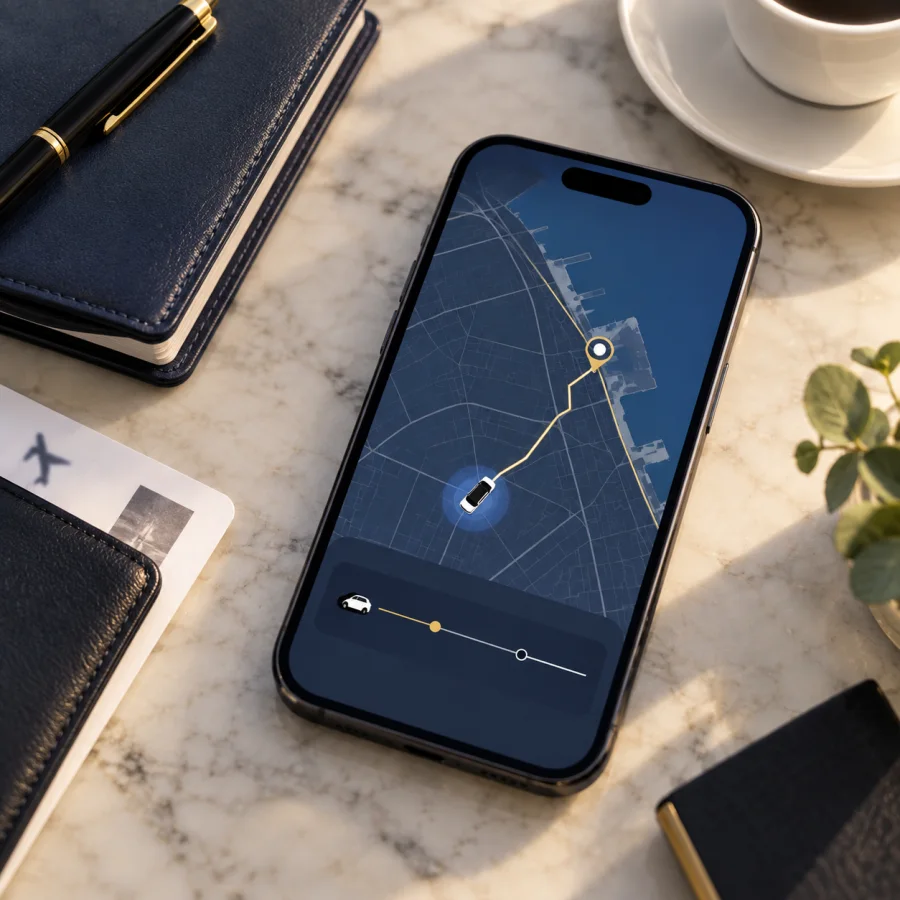
There is a case, already quite well known in the world of service design, that very concretely illustrates how the anxiety of waiting can be intervened upon without altering real time: the live tracking map popularized by transportation apps like Uber.
Before that map existed, requesting a car meant being left with an estimate of minutes and no further certainty. With the map, the user can see the vehicle approaching in real time. The objective wait is exactly the same. What changes is the subjective experience, and that is where psychology comes in.
Behind that effect lies, once again, prior research. Psychologist Suzanne Thompson, in a 1981 study on perceived control, showed that when a person feels they have some control over a situation—even if that control does not alter the final outcome—they experience significantly less stress. Seeing the car approach on a map does not accelerate traffic or the journey, but it returns to the passenger a sense of mastery over something that would otherwise be pure uncertainty.
Added to this is what is known in psychology as the goal-gradient hypothesis, originally formulated by Clark Hull in 1932 and confirmed in later marketing and consumer behavior studies: people feel more motivated and patient as they perceive themselves getting closer to a goal. Seeing a vehicle icon shrinking the distance on a map activates precisely that mechanism. Writer and publicist Rory Sutherland, in his book Alchemy, goes so far as to say that this simple map is equivalent, in terms of customer satisfaction, to a taxi company buying thousands of additional vehicles. It did not change the fleet. It changed what the passenger knew while waiting.
It is worth noting, however, where that mechanism ends. A map resolves the uncertainty of location, but it does not resolve the underlying anxiety described by the Mozio survey: not knowing whom one will meet, whether that person speaks their language, or whether the approaching vehicle is truly the correct one. In a mass, self-managed application, the passenger remains alone facing a screen. In a coordinated executive transfer, that same principle of visibility can be sustained with something no map icon replaces: a real person who confirms the arrival, waits at the exact spot with an identified vehicle, and resolves any unforeseen issue on the spot, without the passenger having to manage it from their phone.
What this means for a real executive transfer
None of these findings suggest that waiting should be resolved by shortening it artificially, something that is almost never possible: flights are delayed, luggage takes time, immigration has its own pace. What they suggest instead is that the perception of waiting can be transformed even when its actual duration does not change, and that concrete, proven mechanisms exist to achieve this.
The first is visibility. A passenger who can see where their vehicle is, or who at least knows with certainty that it has been assigned and is on the way, stops being in the situation of uncertainty described Maister's fourth proposition. Anxiety does not disappear entirely, but it loses the component that fuels it most: not knowing.
The second is proactive communication. Notifying before the passenger has to ask—confirming flight arrival, indicating the exact meeting point, anticipating any delay with a clear reason—directly responds to the fifth proposition: an explained wait is tolerated much better than a silent wait, even if it ends up lasting the same amount of time.
The third relates to immediate recognition. Maister notes that anxiety is higher while a customer is waiting to be served than while they are being served. Applied to an arrival, this means that the moment a driver identifies the passenger, greets them by name, and confirms that the service has begun—even if a few minutes remain before boarding the vehicle—has a disproportionate effect on how the entire wait is remembered afterward.
And the fourth is consistency with what was promised. Maister's sixth proposition speaks of fairness: what a passenger needs to feel, especially after a long flight, is that the process is predictable and orderly for them, without last-minute surprises or ambiguities about who is receiving them or where.

Frequently asked questions
Why does arriving at an international airport generate so much anxiety?
The combination of flight fatigue, disorientation in a new environment, unfamiliarity with distances, and uncertainty about who will receive them and how the meeting will take place create a peak of stress that studies refer to as arrival anxiety.
How can an executive transfer reduce that sense of uncertainty?
Through early coordination, proactive communication before the passenger lands, clear driver identification at the arrivals point, and constant flight monitoring to adapt to any unforeseen delays.
How does a coordinated transfer differ from spontaneous transport?
While a spontaneous service at the terminal involves negotiating fares, searching for vehicles, and dealing with a lack of information, an executive transfer ensures predictability, an assigned meeting point, and a local contact from the very first minute.
Consulted sources and recommended links:
https://www.columbia.edu/~ww2040/4615S13/Psychology_of_Waiting_Lines.pdf Full text by David H. Maister on the psychology of waiting lines.
https://www.traveldailynews.com/statistics-trends/arrival-anxiety-influences-international-travel-bookings-finds-mozio-survey/ Study on the impact of arrival anxiety on international travel bookings.
‹ Back to blog