
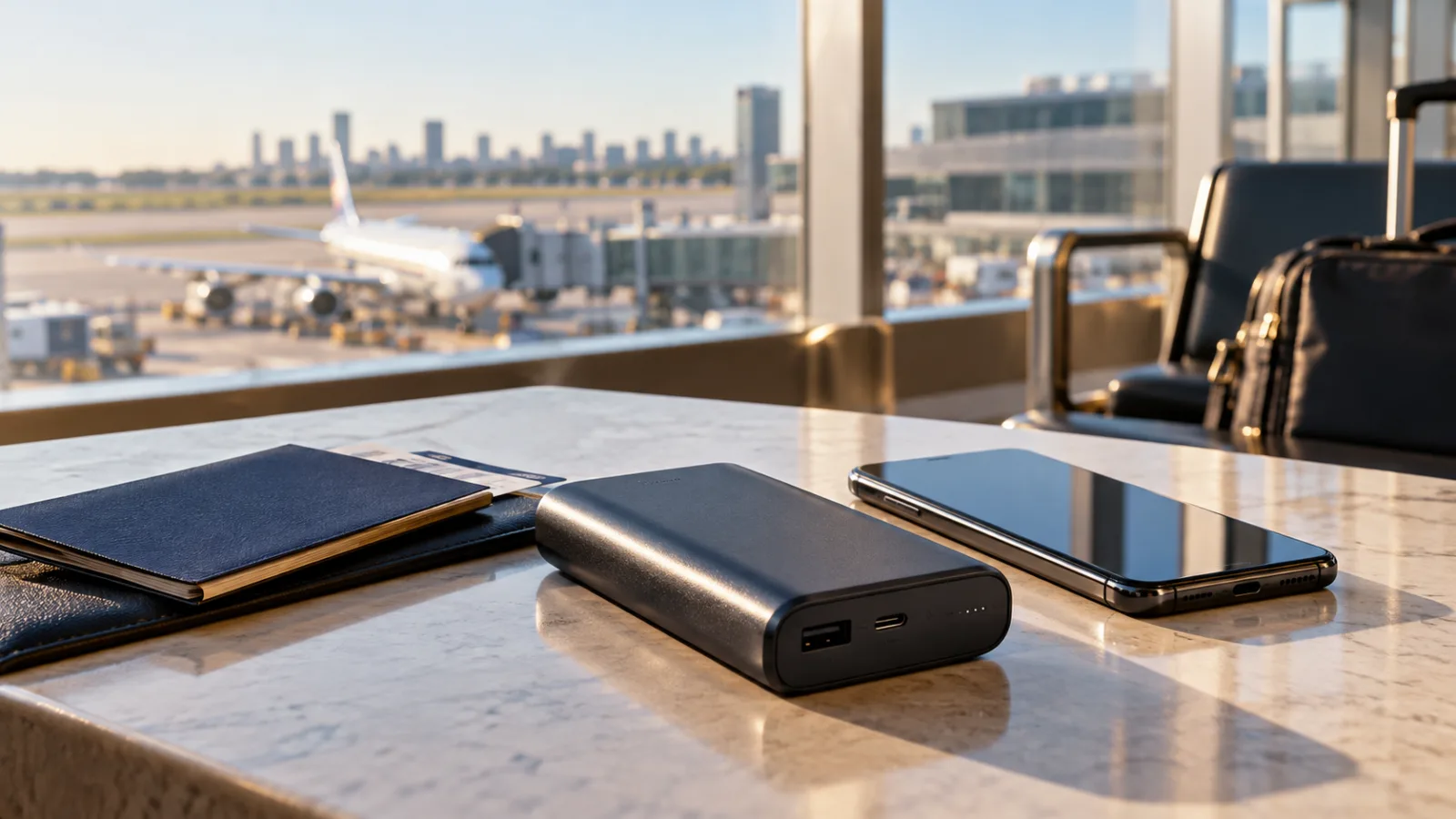
Carrying a power bank on a plane is still allowed, but with stricter rules than a year ago. Since March 27, 2026, the international regulations of ICAO (International Civil Aviation Organization) limit external batteries to two per passenger, up to 100 Wh each, only in carry-on baggage, and prohibit recharging them during the flight. If your power bank exceeds 100 Wh, does not have the capacity printed, or is damaged, it will most likely be removed at the security checkpoint.
This guide gathers what changed, why these devices are confiscated, what conditions yours must meet, and how each country and airline applies the rule.
What changed in 2026 with the ICAO rule?
ICAO incorporated specific provisions for passenger power banks into its Technical Instructions for the Safe Transport of Dangerous Goods by Air (the document known as Doc 9284). They entered into force on March 27, 2026, through addendum no. 1 of the 2025-2026 edition.
The main points are four:
- Maximum of two power banks per passenger.
- Up to 100 Wh each. Above that capacity, the ICAO rule no longer admits power banks for passengers.
- Prohibited from recharging the power bank during the flight, either from the seat outlet or from another device.
- Only in the cabin, never in checked baggage, with terminals protected against short circuits.
Additionally, ICAO recommends not using the power bank to charge other devices on board. It is a recommendation, not an obligation, but many airlines and authorities turned it into a prohibition.
The ICAO norm does not apply automatically in every country. However, most member states adopt these Technical Instructions by reference, which gives airlines legal backing to apply them immediately. That is why some differences still coexist: certain airlines, for example, still accept devices between 100 and 160 Wh with prior authorization.
Why power banks are confiscated?
The risk: thermal runaway
A power bank is a lithium-ion battery. If it suffers a blow, a manufacturing defect, or a short circuit, it can go into thermal runaway: a chain reaction in which the cell heats itself, releases flammable gases, and can catch fire. Once started, it is difficult to stop.
In the cabin, the crew can see the smoke and act in seconds. In the cargo hold, nobody sees it. That is why the basic rule, in force for years, is that spare batteries always travel with the passenger.
The data that accelerated the rules
The tightening was not arbitrary. According to the FAA (Federal Aviation Administration of the United States), in 2024 there were 89 incidents with lithium batteries on board, the highest figure on their record. 27 of them involved external or spare batteries.
Some episodes marked the change in criteria:
- In January 2025, an Air Busan Airbus A321 caught fire at Gimhae airport (South Korea). The most cited cause was a battery stored in the overhead compartment.
- In 2025, the CAAC (Civil Aviation Administration of China) reported 15 cases of smoke or fire from lithium batteries on its flights before restricting power banks without certification.
On August 9, 2026, SWISS flight LX52, between Zurich and Boston, diverted to Dublin due to smoke from a power bank stored in a seat pocket. It landed without injuries.
The seven specific reasons for confiscation
In practice, security or airline personnel remove a power bank when any of these situations occur:
- Exceeds 100 Wh. Some airlines accept up to 160 Wh with prior authorization, but without that authorization, the device does not pass.
- Exceeds the allowed quantity: more than two units since March 27, 2026, or fewer if the airline sets its own limit.
- Does not have legible capacity: the power must be printed or engraved on the casing. A faded label or a homemade sticker is not enough.
- Is damaged: swollen, dented, cracked, with burns or corrosion.
- Is a recalled model by the manufacturer. The FAA expressly prohibits damaged or recalled batteries.
- Travels in checked baggage, including the carry-on suitcase sent to the hold at the boarding gate due to lack of space.
In China, it lacks the 3C mark (CCC, China Compulsory Certification) printed on the device.
How to calculate the Wh of your external battery?
The rule is expressed in watt-hours (Wh), not in milliampere-hours (mAh), which is the figure usually highlighted by manufacturers. The conversion is simple:
Wh = (mAh × volts) ÷ 1,000
Most cells operate at 3.7 V. With that reference value:
- 10,000 mAh equals about 37 Wh.
- 20,000 mAh equals about 74 Wh.
- 27,000 mAh is around 100 Wh, the limit of the ICAO rule.
- Above that capacity, the device no longer meets the general rule.
If the label already indicates the Wh, that is the valid data. If it only shows mAh, it is advisable that the voltage also appears so the checkpoint can do the math.
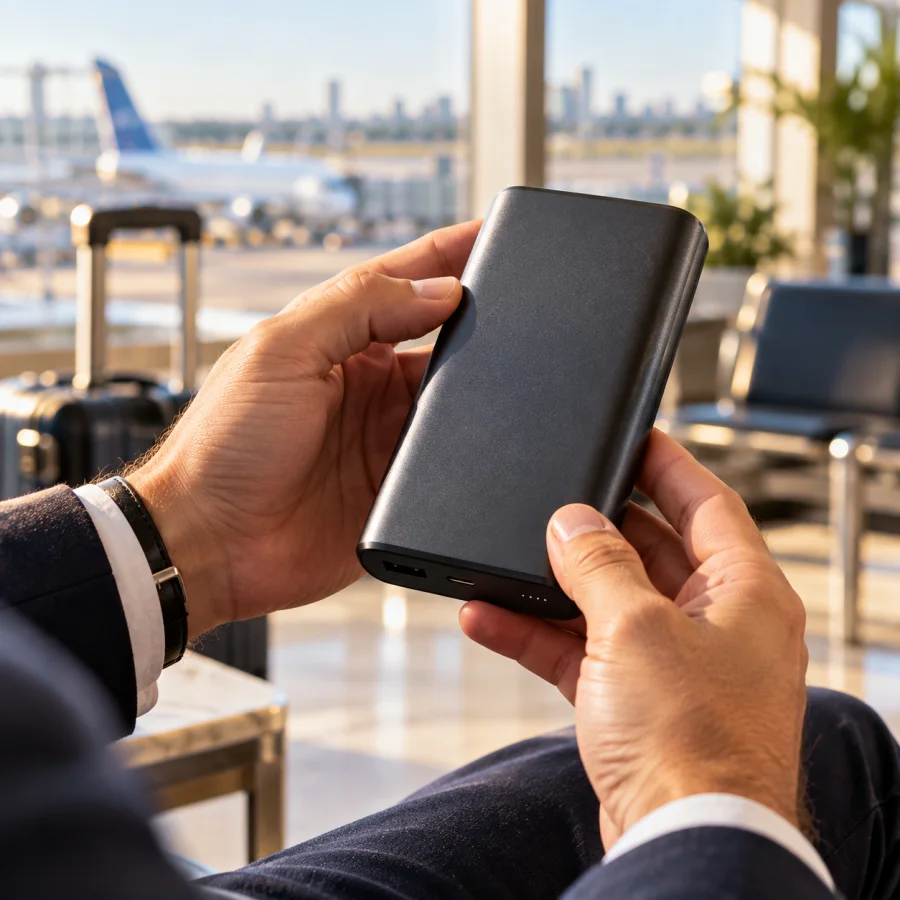
The three capacity ranges
| Capacity | Approximate equivalent at 3.7 V | What the norm allows |
|---|---|---|
| Up to 100 Wh | Up to about 27,000 mAh | Allowed in cabin, maximum two units |
| Between 100 and 160 Wh | Between about 27,000 and 43,000 mAh | Not admitted by the ICAO rule. Some airlines, such as those of the Lufthansa Group, United, and Delta, still accept it with prior authorization |
| More than 160 Wh | More than about 43,000 mAh | Prohibited on passenger flights |
The practical recommendation is simple: travel with devices up to 100 Wh. It is the only range accepted by all airlines.
Conditions your power bank must meet
To pass the checkpoint smoothly, review these points before leaving for the airport:
- Capacity of up to 100 Wh.
- Legible factory label, with brand, model, and capacity in Wh or in mAh and voltage.
- Intact physical state, without swelling, dents, or signs of heat.
- Protected terminals: in its original packaging, with electrical tape over the ports, or in an individual bag.
- Always in carry-on baggage, never in the checked suitcase.
- Current model: if your brand announced a recall, verify that your lot number is not affected.
Where to store it and when to use it on board?
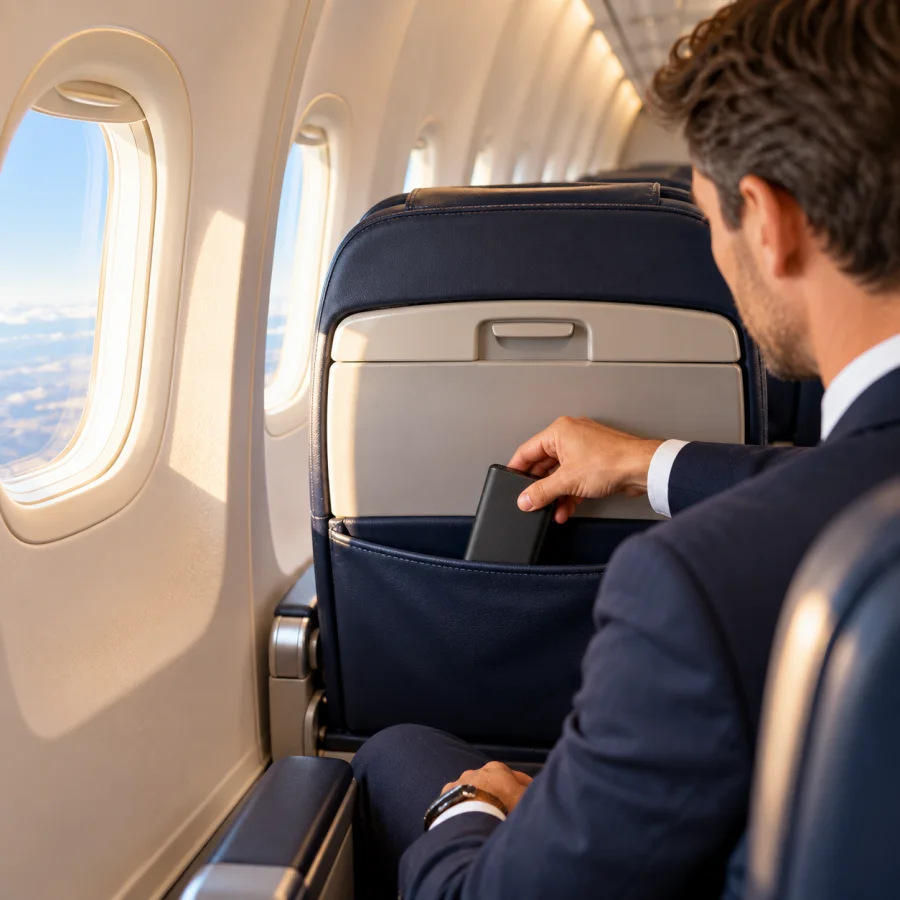
The other novelty has nothing to do with the security checkpoint but with the cabin. Increasingly, airlines require the power bank to remain within the passenger's reach, under the front seat or in the backrest pocket, and prohibit storing it in the overhead compartment: among others, the Lufthansa Group, United, American, South Korean airlines, and flights regulated by the DGCA of India. The logic is the same: if it heats up, someone has to see it.
As for use, three criteria currently coexist:
- Total prohibition of use: you cannot charge the phone or recharge the power bank (LATAM, Lufthansa Group, Emirates, main South Korean airlines, and flights to and from Japan, among others).
- Permitted use with limits: a device can be charged in cruise, but not during taxiing, takeoff, or landing, and never recharge the power bank using the plane's outlet (Copa).
- Visible use: some United States airlines, such as Southwest, allow use only if the device remains in sight.
The practical recommendation is simple: travel with a fully charged phone and consider the power bank as a backup for after landing.
What each country and airline requires?
The basis is common, but application varies. This is the landscape as of October 2026. It is always advisable to confirm with the airline before traveling, because policies change frequently.
Latin America
- Brazil (ANAC): Ordinance no. 21, from April 1, 2026, sets a maximum of two units, only in the cabin, with no recharging on board and no use to charge other devices. Power banks over 160 Wh must be discarded before boarding.
- Colombia (Aerocivil): since April 2026, maximum two units in the cabin, prohibited from using and recharging them in flight, each protected individually.
- Ecuador (DGAC): since March 27, 2026, maximum two units in the cabin, no recharging or use to charge other devices during the flight.
- LATAM: since May 6, 2026, on all its routes, maximum two units of up to 100 Wh, prohibited from using them during the entire flight, and only under the seat.
- Copa: since November 13, 2025, maximum two units of up to 100 Wh, in sight, no use during taxiing, takeoff, or landing.
- Argentina: no specific resolution from ANAC (National Civil Aviation Administration) was identified. As an ICAO member state, the international criterion applies in practice at Ezeiza and Aeroparque, and each airline applies its own policy. Before flying, consult your company's policy.
United States
The FAA maintains the rule by capacity and requires terminal protection, but does not set a quantity for devices up to 100 Wh: each airline decides. American limits to two power banks per passenger since May 1, 2026, prohibits them in the overhead compartment, and does not allow recharging them on board. United prohibits them in the overhead compartment since March 1, 2026. United and Delta accept devices of 100 to 160 Wh only with prior approval and up to two units. If your carry-on bag is checked at the gate, you must remove the power bank before handing it over.
Europe
There is no single prohibition of use for the entire European Union, but EASA (European Union Aviation Safety Agency) issued recommendations that several airlines adopted. Since January 15, 2026, the Lufthansa Group allows two units, prohibits using or charging them on board, and does not admit them in the overhead compartment.
Middle East
Emirates prohibits using power banks on board since October 1, 2025. They can be transported in the cabin, but not connected or used to charge devices.
Asia
- China (CAAC): since late June 2025, on domestic flights, the power bank must have the 3C mark printed on the casing, in addition to legible capacity; recalled models are also prohibited. Several airports, such as Beijing and Shanghai, also check this on international departures. The rule does not apply in Hong Kong or Macau.
- Japan: since April 2026, on flights to and from Japan, maximum two units and prohibited from using or charging them on board.
- South Korea: since March 1, 2025, South Korean airlines do not admit power banks in the overhead compartment. Those of the Hanjin group (Korean Air, Asiana, Jin Air, Air Busan, and Air Seoul) and Jeju Air also prohibit using them on board.
- India (DGCA): a circular from November 11, 2025, prohibits using or charging power banks in flight and storing them in the overhead compartment.
- Singapore Airlines, Thai Airways, and Cathay Pacific also prohibit their use on board.
Recommendations before leaving for the airport
Most confiscations are avoided with a two-minute review at the hotel or office:
- Look at the label under good light. If the capacity cannot be read, it is better not to take that device.
- Count your batteries: the limit is per passenger, not per bag.
- Separate them from the luggage to be checked before leaving, not at the counter.
- Charge your phone to the maximum before the flight, because you probably will not be able to use the power bank on board.
- Review your airline's policy the day before, especially if the trip includes a layover in Asia or a flight with the Lufthansa Group.
A confiscation at the checkpoint does not usually take long, but it does force you to repack your luggage and, sometimes, return to the line. At Ezeiza, where the route between the counter and the boarding gate already takes time, it is advisable to arrive with everything resolved. If your transfer is coordinated in advance and the driver monitors your flight, the margin you gain on the way allows you to make these checks calmly.
Download the full guide (PDF)
Want to keep all of this at hand on your next trip? We put together a free guide with the 2026 rules, the seven reasons a power bank can be removed at security, how to calculate its Wh rating and what each country and airline requires.
👉 Download the PDF guide (available in Spanish)
Save it on your phone and check it before heading to the airport.
Frequently asked questions
How many power banks can I take on a plane in 2026?
Since March 27, 2026, the international ICAO rule allows a maximum of two power banks per passenger, up to 100 Wh each, and always in carry-on baggage. Some airlines set their own limits, so it is advisable to check your company's policy.
Can I charge my cell phone with a power bank during the flight?
It depends on the airline. LATAM, the Lufthansa Group, Emirates, and main South Korean airlines prohibit it, as do flights to and from Japan; Copa allows it during cruise. In all cases, recharging the power bank on board is prohibited.
Why might a 20,000 mAh power bank be confiscated?
A 20,000 mAh power bank is around 74 Wh, so it meets the capacity limit. If it is removed, it is usually because the label is illegible, the device is damaged, you carry more than two, or, in China, because it lacks the 3C mark.
At Aryes Traslados, we coordinate your transfer to Ezeiza or Aeroparque with flight monitoring, so you arrive at the checkpoint with time to spare. Write to us via WhatsApp at +54 9 11 2303-6197.
External links
Technical Instructions
LATAM
Copa
https://help.copaair.com/hc/en-us/articles/36313181600791-Portable-External-Batteries-Power-Banks
‹ Back to blog