
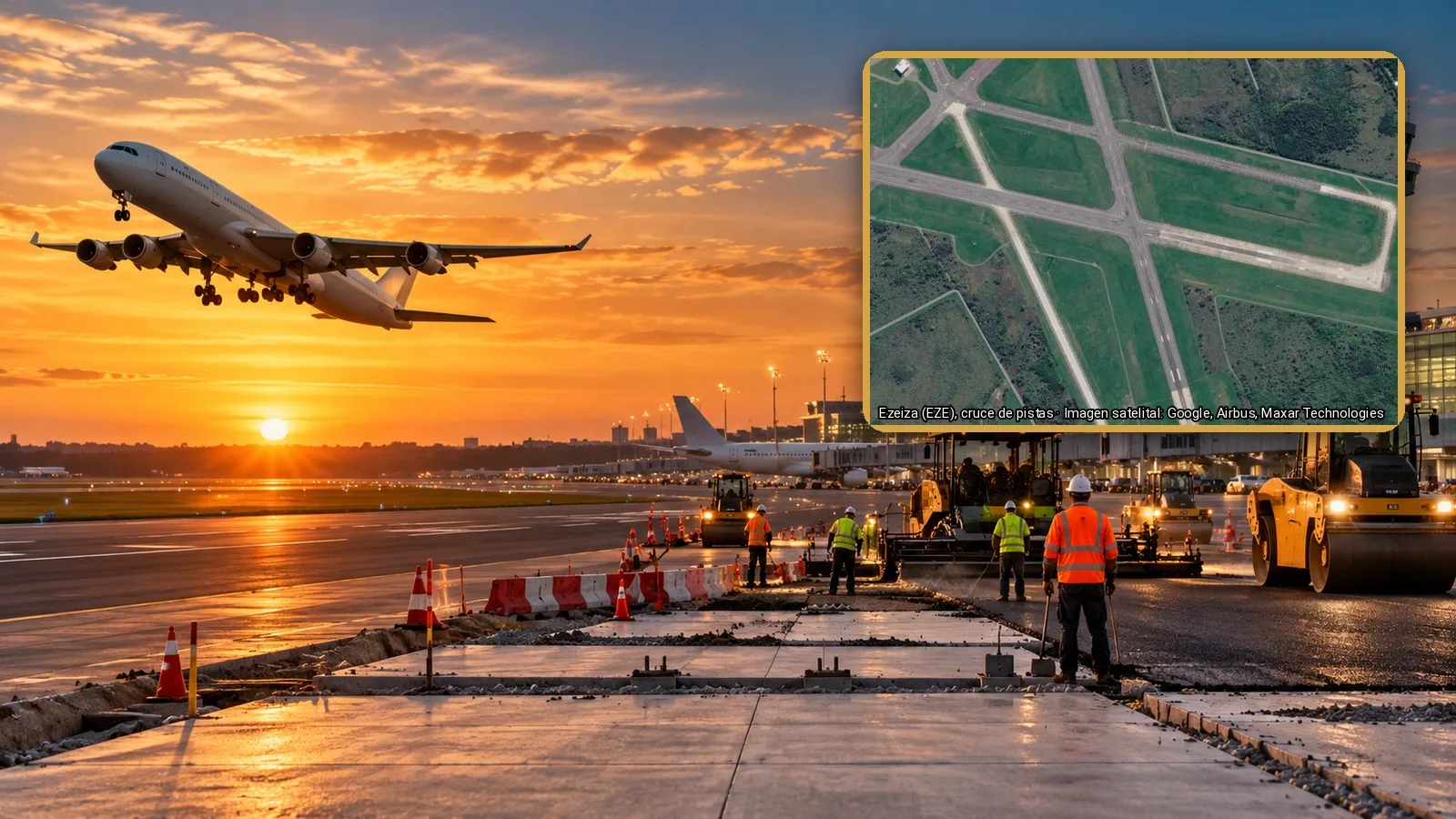
The Ezeiza airport works do not close the airport, but they leave it operating with a single runway at about half its usual length. From October 25 to November 11, 2026, Ministro Pistarini International Airport uses only runway 11-29, shortened from 3,300 to about 1,850 meters, while its crossing with runway 17-35 is rebuilt. As a result, 14 airlines suspend their flights during that period, and several of those that keep flying add technical stops to refuel.
This guide gathers what is known as of October 20, 2026, with the official and press sources behind it. Airlines are adjusting their schedules almost daily, so there is one golden rule: confirm your flight with your airline before you leave.
What works are being done at Ezeiza and why
The works are part of a modernization plan announced on February 25, 2026 by Aeropuertos Argentina, the airport concessionaire, with an investment of about USD 110 million and in coordination with ORSNA (the national airport system regulator). The company presented it as a plan to strengthen operational safety and expand the capacity of an airport that, according to the company, handled about 12 million passengers in 2025.
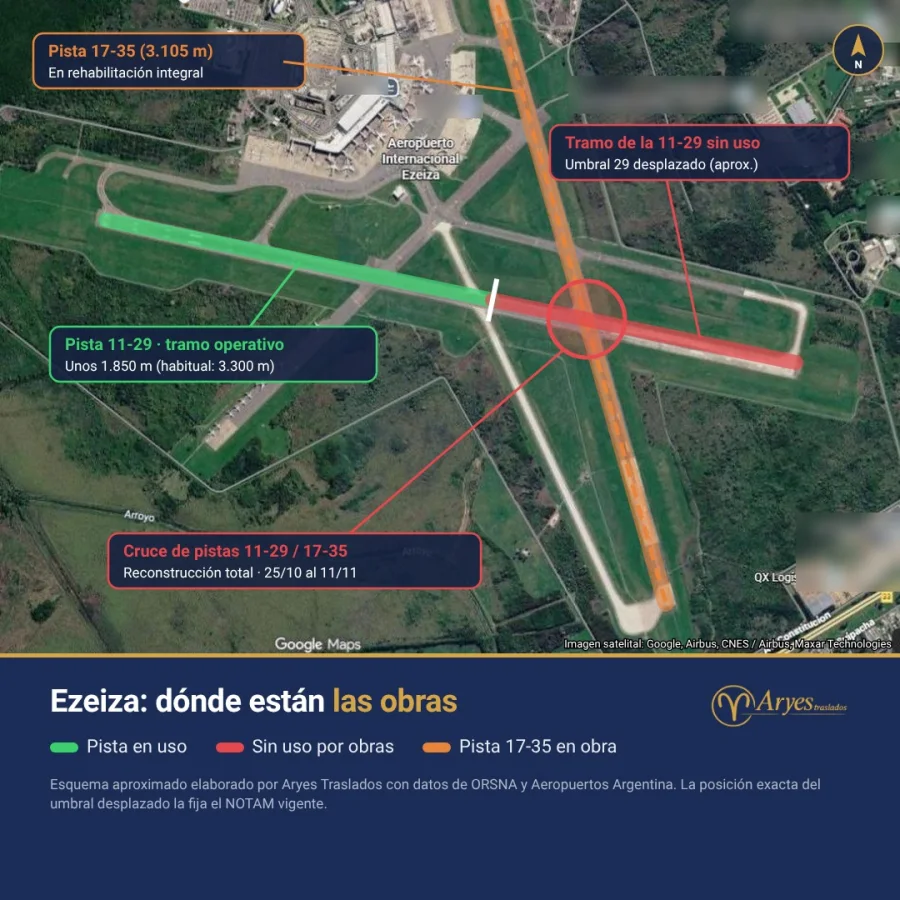
The core of the plan is the full rehabilitation of secondary runway 17-35, 3,105 meters long, which started in August. According to the technical sheet published by ORSNA, it includes:
- Full reconstruction of the 17 and 35 thresholds with 45 cm of high-strength concrete over a 20 cm cement-stabilized base.
- Asphalt pavement renewal in critical sections, with layers of 19 to 23 cm and a 4 cm top layer that improves friction.
- Rehabilitation of taxiway Hotel and the intersections, including the crossing with main runway 11-29.
That crossing is the key. The two runways form a cross, and while the intersection is rebuilt, the main runway cannot be used in full. To avoid closing the airport, the work is done in stages: in the critical stage, runway 11-29 operates with a displaced threshold (the point where landings begin is moved forward), which leaves only part of its length available.
The plan also includes other works that do not restrict flights but will change the airport experience in the coming months:
- Airside: a new apron, called Golf, to park seven single-aisle aircraft; repaving of taxiway Alfa; a new runway lighting ring; and renewable energy for five aircraft stands.
- Terminal: 1,200 m² more in the domestic arrivals terminal, five new boarding gates (for a total of twelve), 3,500 m² of additional pre-boarding space with a new VIP lounge, and the replacement of more than 1,700 check-in, self-service and control devices ready for biometrics.
- Cargo and access: a 12,000 m² single courier terminal, more refrigerated space for perishable exports and a new road link to the Riccheri highway.
Why a shorter runway affects long-haul flights so much
A wide-body aircraft, such as the Boeing 777, the 787, the Airbus A330 or the A350, needs a long runway to take off with enough fuel to cross the Atlantic or reach North America. With about 1,850 meters available, many of those operations are not possible with full tanks.
Faced with that limit, each airline chose one of four paths:
- Take off lighter and make a technical stop to refuel at a nearby airport.
- Reduce seats or cargo to lower the takeoff weight.
- Switch aircraft to one that needs less runway.
- Suspend the route for the period and rebook passengers on partner airlines.
Single-aisle aircraft such as the Boeing 737 or the Airbus A320, which fly regional and domestic routes, need much less runway and generally keep operating.
Which airlines suspend their flights at Ezeiza
According to the latest reports by Aviación News, Ladevi and MDZ (October 2026), 14 airlines do not operate at Ezeiza from October 25 to November 11:
- North America: American Airlines (suspends Miami, New York and Dallas, after considering keeping part of the operation), Delta, United, Air Canada and Aeroméxico.
- Europe: Air France, KLM, Lufthansa, Swiss and British Airways.
- Other regions: Emirates (suspends the Rio de Janeiro–Buenos Aires leg), Ethiopian (São Paulo–Buenos Aires leg), Turkish Airlines and China Eastern.
In most cases, airlines are rebooking passengers on partner flights connecting through São Paulo, Rio de Janeiro, Santiago de Chile, Lima, Bogotá, Panama City or Madrid. The trip may still be possible, but the schedule, flight number and total travel time change.
Which airlines keep flying with a technical stop
A technical stop is a refueling stop: passengers usually stay on board and cannot buy that leg separately. These are the airlines that announced changes:
- Iberia: keeps two daily flights to Madrid with Airbus A330-200s. Flights departing Ezeiza stop in Montevideo.
- Air Europa: operates Boeing 787-8s with a stop in Montevideo on departures from Buenos Aires.
- Level: keeps Buenos Aires–Barcelona with a stop in Montevideo on departures from Argentina, lasting 1 h 30 min to 1 h 45 min depending on the day. Passengers stay on board.
- Plus Ultra: stops in Montevideo and reduces frequencies to Madrid.
- Aerolíneas Argentinas: Madrid and Rome with a stop in Rio de Janeiro on departures from Ezeiza. Miami, Punta Cana, Cancún and Aruba continue without major changes, although schedules may be adjusted.
- ITA Airways: the Rome–Buenos Aires flight arrives nonstop; Buenos Aires–Rome makes a technical stop in Rio de Janeiro, with reduced capacity.
- Copa Airlines: departures from Ezeiza to Panama make a stop of about 45 minutes in Rosario or Córdoba. The inbound leg to Buenos Aires operates normally.
- Arajet: stops in Resistencia or Asunción.
- LATAM: suspends its wide-body Buenos Aires–Miami flight but keeps its regional network.
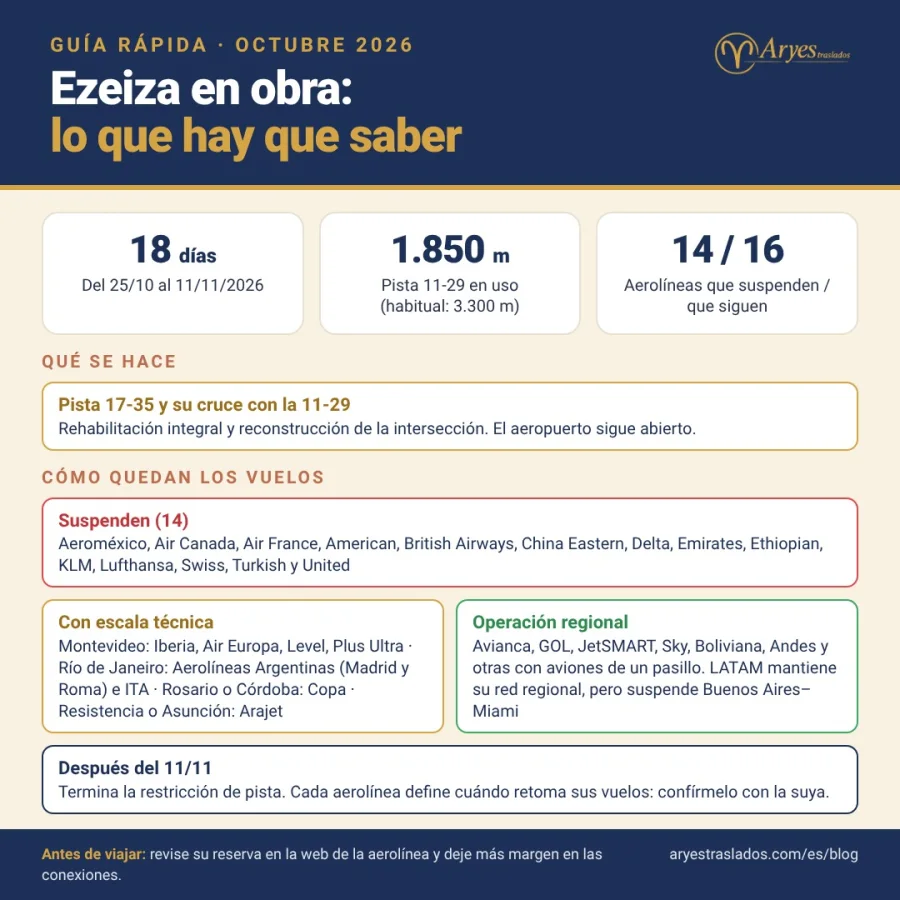
Other regional airlines flying single-aisle aircraft, such as Avianca, GOL, JetSMART, Sky, Boliviana de Aviación and Andes, are listed as operating as planned. Even so, any flight may have occasional schedule changes.
What to do if you have a flight between October 25 and November 11
If your trip falls on those dates, check the following now:
- Your booking: go to "Manage my booking" on your airline's website or app, even if the flight shows as confirmed. Check the time, aircraft, stops and connections.
- Your email and WhatsApp: airlines send rebooking notices and alternatives through those channels. If you bought through an agency, check with them.
- The options you are offered: depending on the case, they may include a free date change, rebooking on another airline or a refund. Each airline has its own policy: Iberia, for example, allows date and airport changes for affected tickets, and Copa allows date changes under certain conditions.
- Onward connections: a technical stop adds time to the trip. If you bought separate tickets, check whether you still make your next flight.
- The departure airport: if you are rebooked on a regional flight connecting in Brazil, Chile or Peru, check whether it leaves from Ezeiza or from Aeroparque. Both airports have regional flights, and mixing them up is one of the costliest mistakes in any itinerary.

How to plan your airport transfer during the works
The Ezeiza terminal keeps working normally: what changes is the timing and shape of many flights. That is why it is best to book your transfer after confirming the final schedule with your airline, not the one shown on your original booking.
For an international flight, the usual advice is to leave the city at least three and a half hours in advance, and on these dates it is worth adding extra time: some airlines moved departure times earlier to make the technical stop, and airline counters will probably be busier. At Aryes Traslados, we set the pickup time with you once your flight is confirmed, so you arrive without rushing.
What happens after November 11
According to the announced schedule, the runway restriction ends on November 11, 2026, and Ezeiza returns to operating with the full main runway. But each airline decides when to resume its flights: Aeroméxico, for example, plans to return on November 11, while British Airways said its nonstop London flight will only return in March 2027. Confirm the restart date with your airline.
https://drive.google.com/file/d/1l8nuc-PRMA3kqwefNovsZIoFSneeNyVS/view?usp=sharing
Frequently asked questions
Is Ezeiza closed from October 25 to November 11?
No. The airport remains open, with its terminals and services running. What changes is that it operates with a single runway, 11-29, shortened to about 1,850 meters, which forces most long-haul flights to be suspended or modified.
Which airlines keep flying from Ezeiza during the works?
Among others, Aerolíneas Argentinas, Iberia, Air Europa, Level, Plus Ultra, ITA Airways, Copa, Arajet, LATAM (except Miami), Avianca, GOL, JetSMART, Sky, Boliviana de Aviación and Andes keep operating. Several of them make technical stops in Montevideo, Rio de Janeiro, Rosario, Córdoba, Resistencia or Asunción.
What should I do if my airline cancelled my flight?
Check your email and the airline's website: it should offer alternatives such as a date change, rebooking on another flight or a refund, according to its policy. If you have not received any proposal, contact its customer service or the agency where you bought your ticket.
If you are traveling during these weeks, message us on WhatsApp at +54 9 11 2303-6197 and we will arrange your transfer to Ezeiza or Aeroparque around your confirmed flight time.
‹ Back to blog